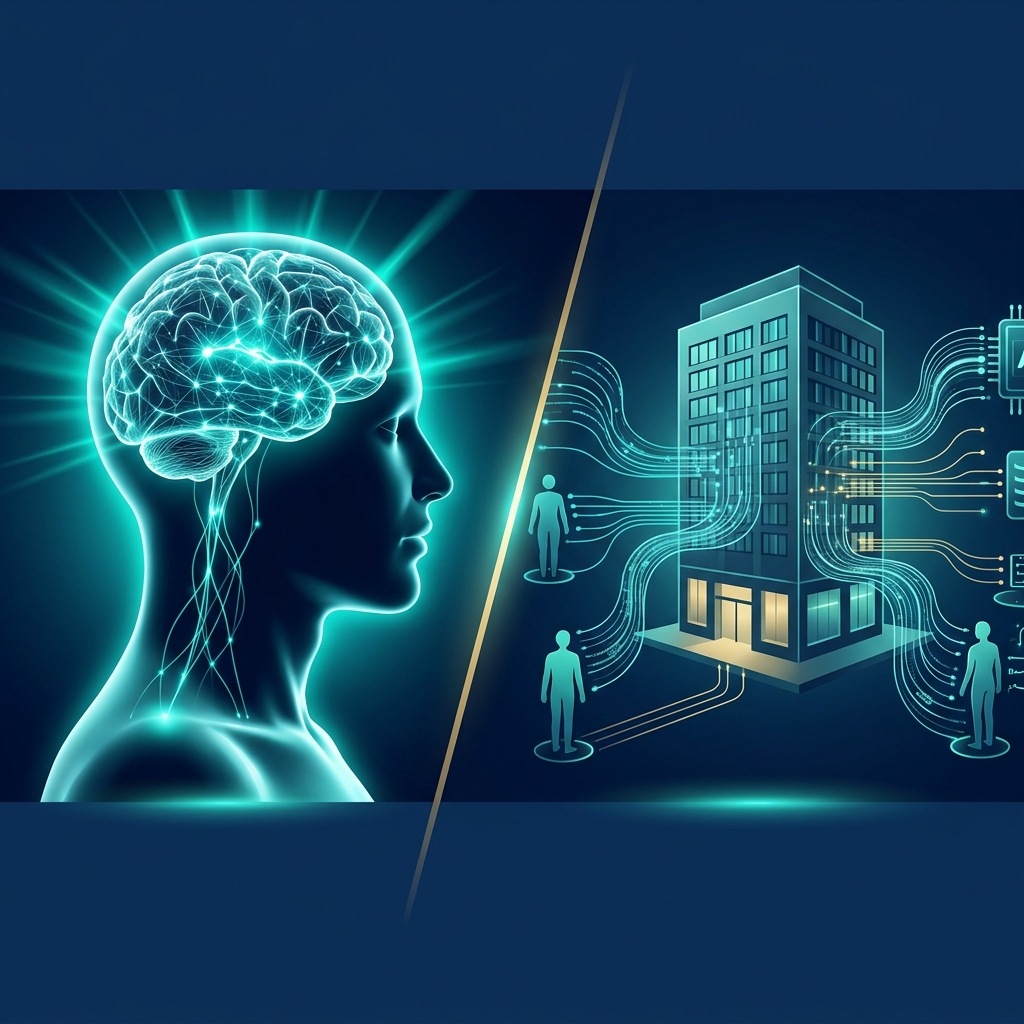
For the past two years, the enterprise AI conversation has been dominated by chatbots and copilots. We have grown accustomed to conversational interfaces where a human types a prompt, and the AI generates a response.
This is merely the prologue.
The true transformative power of Artificial Intelligence lies not in its ability to converse, but in its ability to act. We are entering the era of Agentic AI Architecture—a fundamental shift from systems that assist to systems that execute.

What is an AI Agent?
Unlike a standard LLM, which is essentially a highly sophisticated autocomplete engine, an AI Agent possesses three distinct capabilities:
- Perception: It can read environments, monitor databases, parse incoming emails, or watch system logs without being explicitly prompted.
- Reasoning and Planning: Given a high-level goal (e.g., "Resolve this customer's shipping delay"), the agent can break the goal down into sequential steps, anticipate obstacles, and adapt its plan if it encounters an error.
- Action (Tool Use): Agents are connected to APIs. They can execute code, query databases, send emails, process refunds, and update CRM records autonomously.
When you string these capabilities together, you move from an AI that drafts a response for a customer service rep, to an AI that fully resolves the ticket, updates the database, and emails the customer—all autonomously.
The Power of Multi-Agent Systems
The real magic happens when multiple specialized agents are networked together to solve complex enterprise workflows. This is known as a Multi-Agent System (MAS).
Imagine a software development lifecycle managed by an Agentic Architecture.
- The Requirements Agent translates a product manager's brief into technical specs.
- The Coding Agent writes the initial codebase.
- The QA Agent relentlessly attempts to break the code, sending error logs back to the Coding Agent for iteration.
- The Security Agent scans for vulnerabilities.
These agents converse, debate, and collaborate at machine speed. They do not sleep. They do not suffer context switching. They execute complex, multi-step workflows with a level of coordination that redefines operational efficiency.

Designing for Agency: The Architectural Shift
Implementing Agentic AI requires a radically different technical and philosophical architecture than deploying a simple chatbot.
1. The Orchestration Layer
Agents need a conductor. Frameworks like LangChain, AutoGen, and CrewAI are providing the initial orchestration layers, allowing developers to define agent roles, set communication protocols between agents, and manage the flow of state and memory across the system.
2. The Memory Architecture
For an agent to be truly autonomous, it must remember past interactions, learn from mistakes, and maintain context over long periods. This requires sophisticated integration of Vector Databases (for semantic memory) and relational databases (for episodic and factual memory).
3. The Guardrail Infrastructure
This is the most critical component. When you grant an AI the ability to execute actions via APIs, the cost of a hallucination shifts from an embarrassing typo to a potentially catastrophic business error.
Agentic architectures demand hard-coded, deterministic guardrails. If an autonomous procurement agent decides to order 10,000 laptops instead of 10, it must hit an un-bypassable authorization limit that forces a human into the loop.
Human-Centred Agentic AI
There is a fear that Agentic AI means the total removal of the human workforce. The reality of enterprise deployment is much more nuanced.
The most successful Agentic Architectures are deeply Human-Centred. They employ an "Autonomy with Escalation" model. The agents handle the 80% of workflows that are predictable and mundane. But when they encounter edge cases, ethical dilemmas, or high-stakes financial decisions, the architecture is designed to cleanly hand off context to a human supervisor.
The human role transitions from the operator of the process to the governor of the system.
The Path Forward
Enterprise leaders must begin piloting agentic workflows today. The shift from conversational AI to agentic AI is not a subtle upgrade; it is a step-function increase in capability.
Start small. Identify a multi-step, rules-based workflow that is currently a bottleneck. Build a two-agent system to automate it. Learn how to monitor their interactions, manage their memory, and establish secure API access.
The future of the enterprise is not human versus AI. It is teams of humans orchestrating networks of highly capable, autonomous AI agents.
Amit Kumar Soni
Leading the charge in responsible AI transformation. We help global enterprises align AI systems with human-centric governance, scaling intelligence securely and sustainably.
Read our story