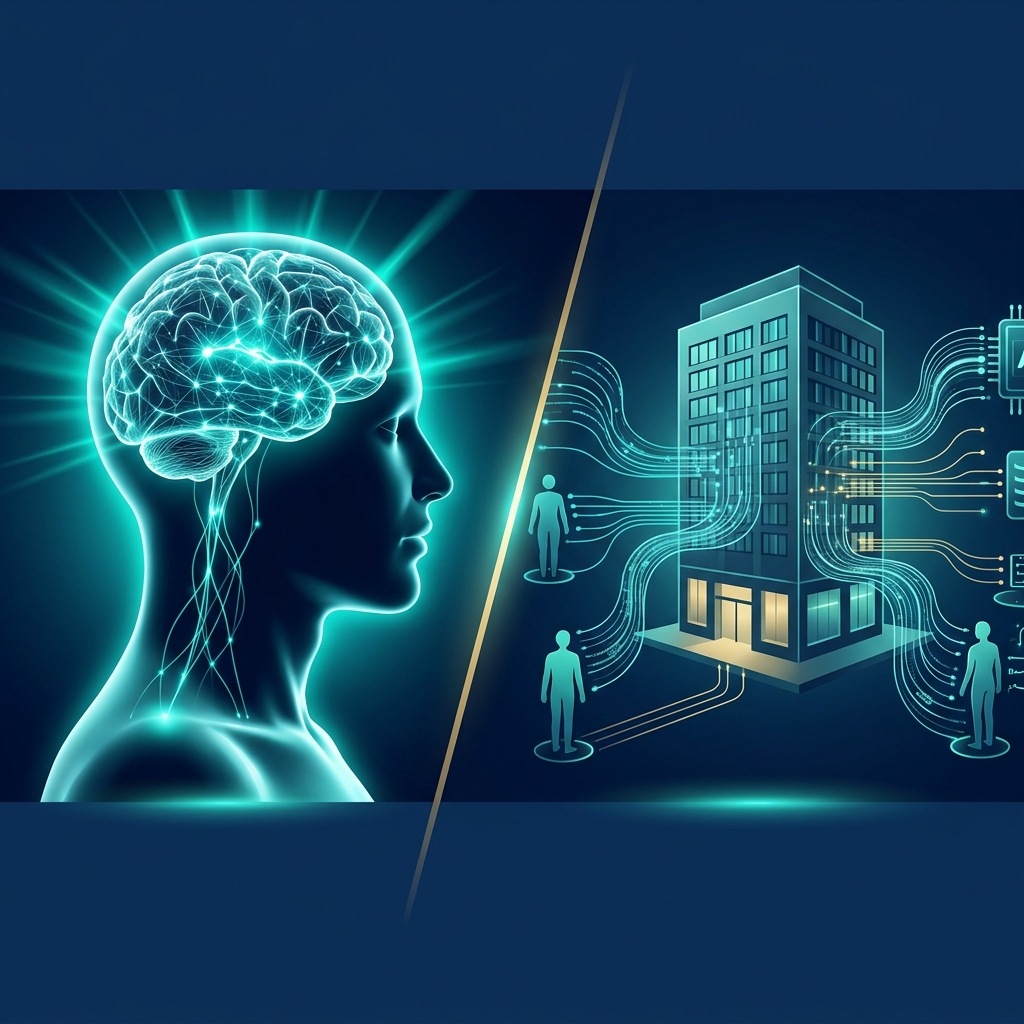
Most AI conversations in the boardroom focus on the wrong thing.
Speed. Cost. Competitive advantage. These matter. But they miss the question that determines whether your AI investment actually works: Are the humans in your organisation ready for this?
That's what human-centred AI is really about.
Not slowing AI down. Not adding ethical checkboxes to a slide deck. It's about building AI systems that people can actually use, trust, and work alongside — without burning out, making critical errors, or losing accountability.
This guide breaks it down for enterprise leaders. No jargon. No theory. Just what it means, why it matters, and what you should actually do about it.
Let's Start With the Basic Definition
Human-centred AI (HCAI) is an approach to designing, deploying, and governing AI systems with the human at the centre of every decision.
That means three things:
- AI should augment what humans do, not replace the judgment call.
- People who work with AI should understand it well enough to catch when it's wrong.
- The organisation as a whole should be able to explain, monitor, and correct its AI systems.
The concept isn't new. Researchers like Ben Shneiderman at the University of Maryland have been writing about it for years. The EU AI Act built regulatory requirements around it. ISO 42001, the international standard for AI management systems, is structured on these principles.
What's new is the scale of the problem. Enterprises are deploying AI across every function: HR, finance, legal, customer service, procurement. And most of them haven't thought carefully about the human side.

The Autopilot Analogy
Think about how autopilot works on a commercial aircraft.
The system can fly the plane. It handles altitude, speed, course corrections. It's sophisticated, reliable, and saves thousands of hours of manual work per year. But pilots are still in the cockpit. They monitor the system. They handle anything it can't. They take over when conditions change.
Now imagine removing the pilots entirely and trusting the autopilot to handle everything, including situations it has never seen before.
That's what poor AI deployment looks like. The system runs. Nobody's watching. And when something goes wrong, nobody knows how to intervene because they've stopped understanding the system.
Human-centred AI keeps the pilot in the cockpit. The AI does the heavy lifting. The human stays informed, alert, and in control.
Why Enterprise Leaders Get This Wrong
Most enterprises approach AI in one of two ways. Neither works.
The first way: Move fast and figure it out later. Deploy the tools, train people in a weekend, and assume the ROI will follow. This leads to shadow AI (employees using tools the organisation hasn't approved), poor decisions made on flawed AI outputs, and a compliance risk that grows quietly in the background.
The second way: Overthink the governance. Create committees. Write policies. Delay deployment by 18 months while competitors move. This produces a governance framework with no practical use, and AI adoption happening anyway, just without any structure around it.
The right path sits between these two extremes. It starts by asking a simple question: Are your people ready to work with AI responsibly?
Not "can they click the buttons." Ready means they understand what the AI can and can't do. They know when to trust the output and when to question it. They know what to do when the system behaves unexpectedly.
That readiness doesn't happen automatically. It requires design. That's where human-centred AI begins.

The Five Principles That Actually Matter
There are dozens of frameworks for human-centred AI. Most say similar things in different words. Here's what the core principles look like in plain English, for a business context.
1. Transparency
People need to understand what AI is doing and why.
This doesn't mean they need a computer science degree. It means a claims assessor at an insurance company should know that the AI scoring tool they use was trained on certain data, has known limitations, and should not be the sole basis for a denial. They should be able to say "I'm not sure I trust this output" without being penalised for it.
Transparency is not about publishing model documentation nobody reads. It's about the everyday context people have when they work with AI tools.
2. Accountability
Someone must be responsible when AI gets it wrong.
This sounds obvious. But in large organisations, responsibility gets diffused. The vendor says the model performed as expected. The IT team says they deployed it correctly. The business unit says they were following the process. Meanwhile, a customer was harmed, an employee was wrongly scored, or a procurement decision cost the company millions.
Human-centred AI names the accountable person upfront. Before the system is deployed. Not after something breaks.
3. Human Oversight
AI should support decisions, not make them unilaterally.
For low-risk, high-volume tasks, automated decisions are fine. Sorting emails, tagging data, generating first drafts. But for decisions that affect people's jobs, health, finances, or freedoms, a human should be in the loop. That's not just an ethical position. In many jurisdictions, it's now a legal requirement.
The EU AI Act specifically prohibits certain types of automated decision-making without meaningful human review. India's Digital Personal Data Protection Act has similar provisions. Enterprise leaders who aren't aware of this are building legal exposure into their AI programs right now.
4. Fairness and Bias Awareness
AI systems reflect the data they were trained on. That data reflects human history. Human history includes systematic bias.
A hiring tool trained on 10 years of CVs from a company that historically promoted mostly men will learn to favour profiles that look like those men. Not because anyone programmed it to. Because that's what the data showed.
Human-centred AI requires regular audits for bias, diverse training data where possible, and clear processes for challenging AI outputs that seem unfair.
5. Workforce Readiness
This is the one most enterprises skip.
You can have the best governance policy in the world. If your people don't understand AI, they'll either over-trust it or ignore it. Both outcomes are bad.
Workforce readiness means employees at every level have the baseline knowledge to work with AI tools appropriately. Not deep technical training. Practical literacy. What can this tool do? What can't it do? What are my responsibilities when I use it?
A 40-hour certification isn't always necessary. But a culture where nobody asks these questions is a liability.

What This Looks Like Inside a Real Enterprise
Let me make this concrete.
Imagine a professional services firm deploying an AI tool to assist with contract review. The tool flags risk clauses, summarises key terms, and suggests redlines. It's good. It works most of the time.
Here's how this goes wrong in a company without human-centred AI thinking:
Lawyers start relying on the tool heavily. They stop reading contracts as carefully as they used to. One day, the tool misses an unusual indemnity clause in a high-value agreement. The lawyer assumes the tool caught everything important. The clause goes unaddressed. The client faces unexpected liability.
Nobody did anything dishonest. The tool wasn't broken. The process failed because humans had outsourced their judgment without realising it.
Here's how it goes right:
The firm deploys the same tool, but with training for every lawyer on what the tool can and cannot catch. They establish a clear policy: AI-assisted review must be followed by human sign-off for any contract above a certain value. They run quarterly checks on AI performance, looking for patterns in what it misses.
Same technology. Very different outcome.
The ISO 42001 Connection
If you're an enterprise leader working on AI governance, ISO 42001 is the standard you need to know.
It's the international standard for AI management systems. Think of it like ISO 27001 for information security, but built specifically for AI. It provides a framework for establishing policies, risk assessments, human oversight mechanisms, and continuous improvement processes.
ISO 42001 is explicitly built on human-centred principles. It requires organisations to identify AI impacts on people, maintain accountability structures, and demonstrate that AI use aligns with organisational values.
For enterprises operating in regulated industries, or those looking to demonstrate responsible AI to clients and investors, ISO 42001 alignment is fast becoming a baseline expectation, not an optional extra.
Three Questions Enterprise Leaders Should Ask Right Now
You don't need a three-year transformation to start.
Ask these three questions. The gaps they reveal are where your work begins.
1. Who is accountable for each AI system in our organisation?
Name the person, not the team. If you can't do that, you have an accountability gap.
2. Do our employees know when to override an AI decision?
Can they articulate when an AI output should be questioned? Do they feel safe raising concerns? Or has the pressure for speed created a culture where questioning the tool feels like slowing things down?
3. Do we have a process for when AI gets it wrong?
Mistakes will happen. The question isn't whether your AI will fail. It's whether you'll know when it does, and whether you have a clear path to respond. If that process doesn't exist, build it before you need it.
Why This Is a Leadership Issue, Not Just an IT Issue
Here's something that doesn't get said enough: the human-centred AI challenge is not technical.
Your IT team can't solve it. Your AI vendor won't solve it. It's a leadership challenge about culture, accountability, and organisational readiness.
Leaders set the tone. If the message from the top is "deploy AI faster," people will deploy it faster. If the message is "deploy AI responsibly and explain how," people will do that instead.
The organisations getting this right aren't necessarily the ones with the best AI tools. They're the ones where leadership has asked hard questions about readiness, accountability, and trust. And then built systems to answer those questions honestly.
What You Should Do Next
If this has raised concerns, here's where to start:
Map what you have. List every AI system currently in use across the organisation. Who uses it? Who approved it? Who's responsible when it fails?
Assess workforce readiness. A short survey with your department heads will tell you more than a month of analysis. Ask people directly: do they understand the tools they're using? Do they know when not to trust them?
Set governance before scale. If you're about to roll out a new AI system, put the accountability structure in place first. It's far easier to do before deployment than after something breaks.
Train for judgment, not just tools. Your people don't need to understand how the model works. They need to know how to work with it responsibly. That's a different kind of training, and it's one most organisations haven't delivered yet.
The Bottom Line
Human-centred AI isn't about being cautious. It's about being smart.
The companies that will get the most from AI over the next decade are not the ones that deploy the fastest. They're the ones that build the human infrastructure to use it well: the culture, the governance, the readiness, the accountability.
That's what human-centred AI means in practice.
And it starts with leadership deciding that the human side of this equation is just as important as the technical side. Because it is.
Amit Kumar Soni is the Founder and CEO of Mindacks and the Mindacks Human-Centred AI Institute (MHCAI). He works with enterprise leaders across Asia and beyond to build AI governance frameworks, workforce readiness programs, and responsible AI cultures. His philosophy: Mind First. Future Ready.
Amit Kumar Soni
Leading the charge in responsible AI transformation. We help global enterprises align AI systems with human-centric governance, scaling intelligence securely and sustainably.
Read our story