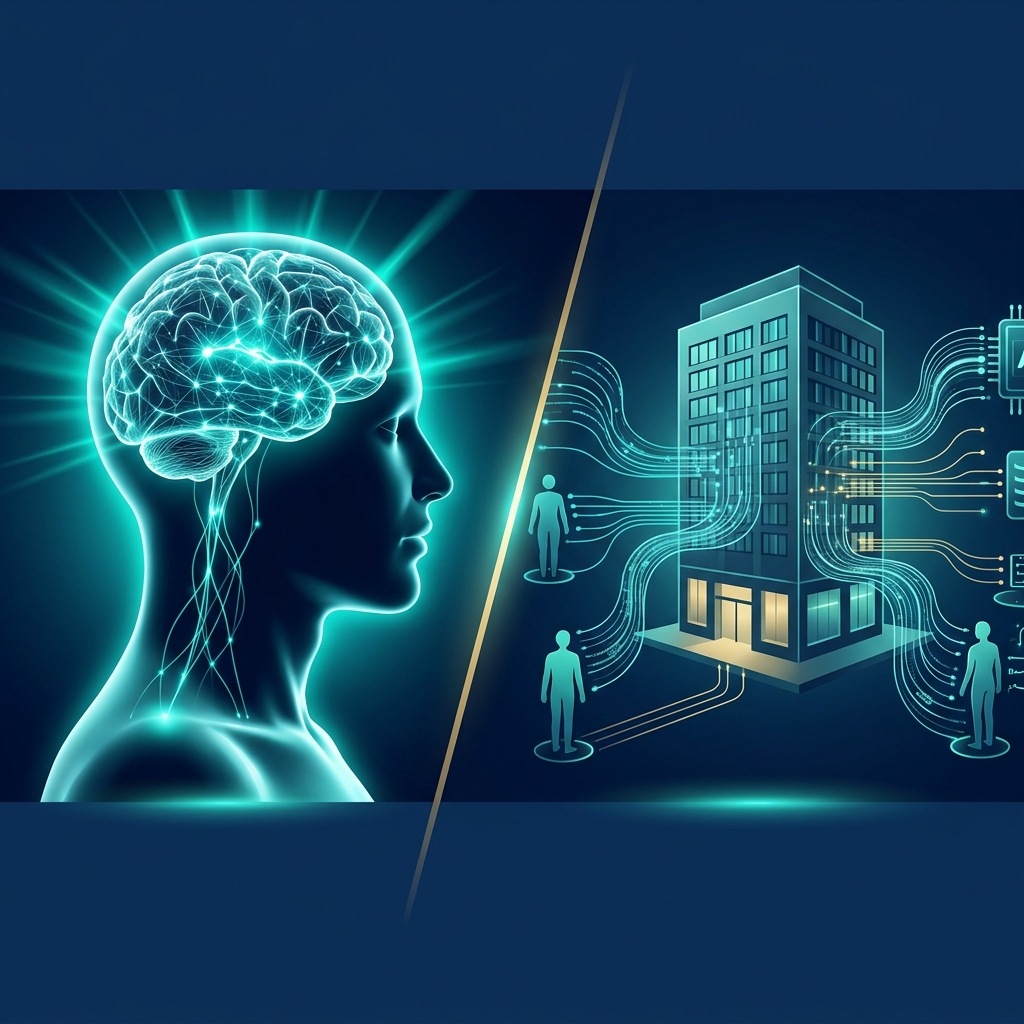
Agentic AI Is Coming for Your Workforce: Are You Ready or at Risk?
In the context of agentic AI workforce, for the first five years of the enterprise AI era, AI was a tool. You gave it a task. It produced an output. A human reviewed that output and decided what to do next.
[!IMPORTANT] Key Takeaways:
- Agentic AI systems that reason and plan autonomously represent the next major wave of enterprise automation.
- Workforce readiness is the single greatest bottleneck to scaling autonomous agent workflows successfully.
- Leaders must transition from task-based training to cognitive collaboration readiness for hybrid human-agent teams.
That model is changing.
Agentic AI systems don't wait for instructions. They receive a goal, break it into sub-tasks, select tools, take actions, and iterate until the objective is achieved — with minimal human involvement in the process. They book travel, execute trades, write and run code, manage supplier communications, and coordinate across software systems, often completing workflows that would have taken a human hours in a matter of minutes.
Gartner named agentic AI as the number one technology trend for 2025. According to Gartner research, by 2028, at least 15% of day-to-day work decisions at enterprise level will be made autonomously by AI agents, up from near zero in 2024.
This is not a distant scenario. It's already in production at organisations across financial services, technology, and professional services. The question for enterprise leaders is not whether agentic AI will reach your workforce. It's whether you're building the infrastructure — governance, skills, and processes — to work with it safely and effectively.
Table of Contents
- What Agentic AI Actually Is
- The Scale of Disruption — and Opportunity
- Where Agentic AI Is Already Deployed
- The Three Risks Nobody Is Talking About
- Human Oversight in Agentic Systems: The MHCAI Model
- Building Human-Agent Teams That Work
- Why Mindacks and MHCAI Approach This Differently
- Frequently Asked Questions
- Ready to Prepare Your Workforce?
1. What Agentic AI Actually Is
Agentic AI refers to AI systems with four key characteristics:
Goal-directed: The system receives a high-level objective and determines how to achieve it, rather than executing a single pre-specified task.
Tool-using: Agentic systems can access and operate external tools — web browsers, databases, APIs, software applications — to complete tasks.
Multi-step reasoning: The system plans, executes, evaluates outcomes, and adjusts its approach iteratively.
Autonomous action: Within defined parameters, the system can take actions — send emails, execute code, update records, place orders — without requiring a human approval step for each action.
Examples include Microsoft Copilot agents in enterprise Microsoft 365 environments, Salesforce Agentforce in CRM operations, and custom agent architectures built on models like Claude, GPT-4, and Gemini using frameworks such as LangChain, AutoGen, or CrewAI.
Agentic AI is not general artificial intelligence. It operates within defined domains and has significant limitations. But within those domains, its capability to compress complex multi-step workflows is genuinely transformative.
2. The Scale of Disruption — and Opportunity
The World Economic Forum's Future of Jobs Report 2025 identifies AI and automation as the primary driver of workforce transformation through 2030. The report projects 170 million new jobs globally, offset by approximately 92 million displaced roles — a net gain but with significant disruption in the transition.
Agentic AI accelerates this curve. McKinsey estimates that up to 30% of hours currently worked in the US economy could be automated by 2030, with agentic systems driving a significant portion of that automation in knowledge-work sectors.
The opportunity is equally large. Early adopters of agentic AI in financial services report 50–70% reductions in processing time for routine analytical tasks. In customer service, Gartner projects that by 2027, autonomous agents will resolve 80% of routine customer service issues without human involvement.
The disruption and the opportunity are two sides of the same reality. Organisations that manage the transition thoughtfully will capture the productivity gains. Those that don't will face a workforce unprepared to work alongside autonomous systems — or a governance failure that forces a retreat.

3. Where Agentic AI Is Already Deployed
Understanding the current deployment landscape helps organisations assess their exposure and opportunity.
Financial Services Investment banks and asset managers are deploying agents for market research synthesis, regulatory filing preparation, and client communication workflows. JPMorgan Chase has publicly disclosed AI systems that perform the equivalent of 360,000 hours of lawyer work per year in contract intelligence operations.
Professional Services Law firms and consulting firms are using agents to conduct due diligence, synthesise research across large document corpora, and draft initial deliverables. The efficiency gains are real, but so are the liability questions around AI-assisted professional work.
Technology and Engineering Software development agents — GitHub Copilot, Cursor, and similar tools — are already operating in autonomous code generation and testing cycles. Deloitte's 2024 AI survey found that 25% of enterprise software teams have deployed some form of autonomous coding agent.
Customer Operations Retail, telecommunications, and utilities organisations are deploying conversational agents capable of completing end-to-end customer transactions — not just answering questions but executing account changes, processing claims, and managing complaints with minimal human escalation.
4. The Three Risks Nobody Is Talking About
Risk 1: The Accountability Vacuum
When a human makes a wrong decision, accountability is clear. When an agentic system makes a wrong decision — sends an incorrect communication, executes an unauthorised transaction, misroutes a service request — accountability is murky. Was it the model? The configuration? The person who set the objective? The organisation that deployed it?
Without explicit governance frameworks for agent accountability, organisations are creating accountability vacuums that regulators will fill for them.
Risk 2: Skill Atrophy
As agentic systems handle more complex, multi-step processes, the humans nominally overseeing those processes begin to lose the underlying skills. This mirrors what happened to certain trading desk functions after automated trading became dominant — the institutional knowledge of how to operate without the automation eroded faster than expected.
Organisations need deliberate programmes to maintain core human skills in functions that are becoming agent-assisted, particularly for scenarios where agent failure or system outage requires human backup.
Risk 3: Trust Without Verification
Because agentic systems often operate faster than humans can track, there is a natural tendency to trust outputs without adequate verification. This is the same over-reliance risk seen with earlier AI tools, but amplified by the autonomous nature of agentic execution. An agentic system that completes 500 sub-tasks correctly before making a material error may have built enough trust credit that the error goes unchecked.
5. Human Oversight in Agentic Systems: The MHCAI Model
The central challenge with agentic AI is maintaining meaningful human oversight without sacrificing the efficiency gains that make the technology valuable. MHCAI's model identifies three tiers of oversight:
Tier 1: Autonomous Zone Low-risk, high-volume, reversible tasks where agent execution without human review is appropriate. Scheduling, data retrieval, routine communication formatting.
Tier 2: Monitored Zone Medium-complexity tasks where humans receive notifications of agent actions and can intervene if patterns look anomalous. Analytical synthesis, draft communications, data processing.
Tier 3: Human-in-Loop Zone High-stakes, consequential, or irreversible actions that require human approval before execution. Financial transactions above defined thresholds, external communications on sensitive topics, decisions affecting individuals.
The critical governance work is not just defining these tiers. It's ensuring that the humans in Tier 3 oversight roles actually have the knowledge and capacity to perform that oversight meaningfully.
6. Building Human-Agent Teams That Work
The most productive organisations won't be those that deploy the most agents. They'll be those that design the best human-agent collaborations.
This requires clarity on three questions for every agentic deployment:
What does the agent do well that humans don't? Speed, consistency, scale. Identify tasks where these advantages are decisive.
What do humans do well that agents can't? Contextual judgment, ethical reasoning, relationship management, creative problem-framing. Protect these capabilities actively.
Where must the handoff be? Define the precise points where human judgment must enter the process, and build hard stops into agent workflows at those points.
This is not just a technical design question. It's a workforce design question that requires HR, operations, and governance leadership to work alongside technology teams.
7. Why Mindacks and MHCAI Approach This Differently
Most agentic AI programmes are designed by technology teams and implemented on workforces that haven't been prepared. Mindacks approaches agentic AI from the human side first.
Our workforce readiness programmes for agentic AI are built around four competencies: understanding what agents can and cannot do, designing effective human-agent workflows, maintaining oversight without creating friction, and building the institutional knowledge to operate safely when agents fail.
We've designed agentic AI readiness programmes for organisations in financial services, pharmaceutical, and professional services sectors across Asia and the Middle East.
Frequently Asked Questions
What is the difference between regular AI and agentic AI?
Traditional AI receives a task and produces an output. Agentic AI receives a goal and autonomously plans and executes multiple steps to achieve it, using external tools and adapting its approach based on intermediate results.
Is agentic AI already in enterprise use?
Yes. Major enterprises in financial services, technology, and professional services have active agentic AI deployments. The technology is no longer experimental — it is in production.
How should organisations govern agentic AI?
Through a tiered oversight model that assigns human review requirements based on the risk level of tasks, combined with clear accountability structures, audit logging of agent actions, and defined intervention protocols.
What skills do employees need to work alongside agentic AI?
Effective human oversight of agentic systems requires understanding what agents are optimising for, recognising when outputs require scrutiny, and knowing the escalation pathway when something looks wrong.
What is the EU AI Act's approach to autonomous AI systems?
The EU AI Act classifies autonomous AI systems based on risk level. High-risk systems — which include many agentic applications in consequential domains — require human oversight mechanisms, documentation, and in some cases, prior conformity assessments.
Ready to Prepare Your Workforce for Agentic AI?
The organisations that build human-agent collaboration capability now will run faster, smarter, and more safely than those scrambling to catch up. Don't wait for a governance failure to build the infrastructure.
Book an Agentic AI Readiness Workshop with Mindacks.
Take the Next Step with Mindacks
The gap between AI investment and AI impact is not inevitable. It's a solvable problem — but only if the human side of the equation gets the same attention as the technology.
Book a complimentary AI Readiness Assessment with Mindacks. We'll map where your organisation stands, benchmark your readiness against ISO 42001, identify your highest-priority gaps, and give you a clear, actionable path forward.
Authoritative References & Further Reading
- Gartner: Predicts 2026: Agentic AI Systems
- Stanford HAI: Future of Work and AI Agents
Amit Kumar Soni
Leading the charge in responsible AI transformation. We help global enterprises align AI systems with human-centric governance, scaling intelligence securely and sustainably.
Read our story